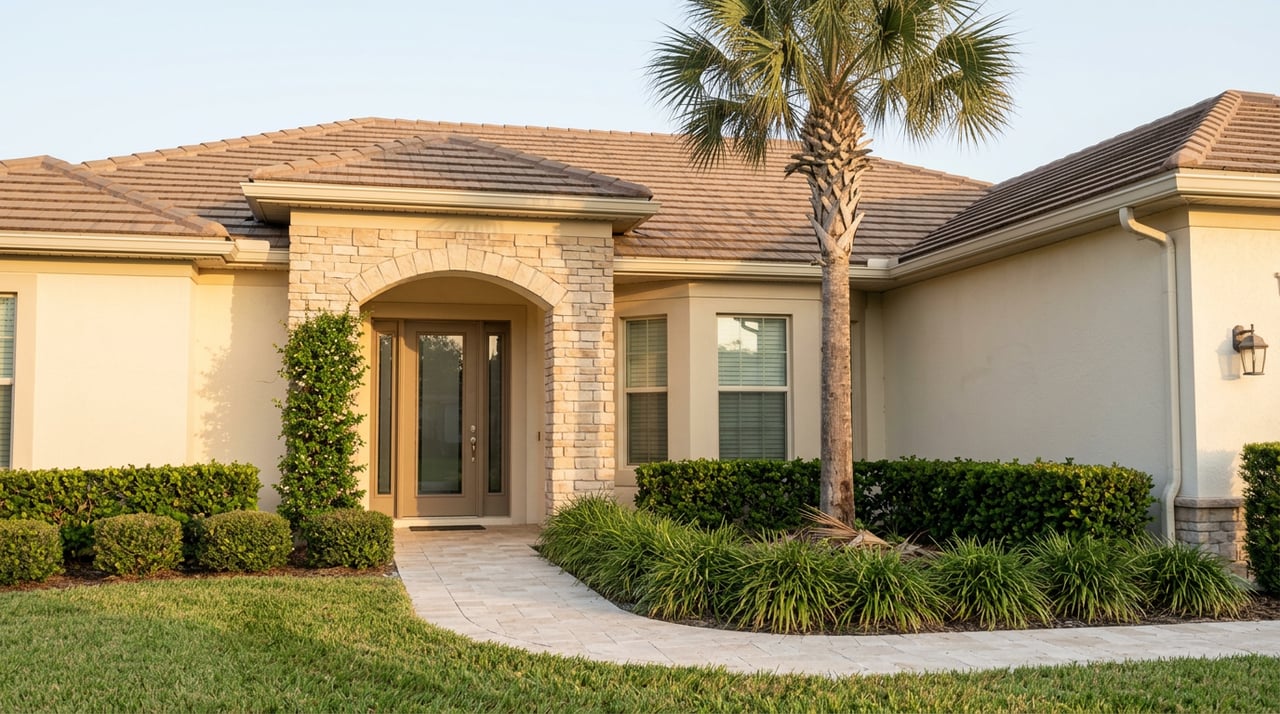
Why Venetian Falls Skips the Fee Almost Every Wellen Park Neighbor Pays
September 24, 2026
September 24, 2026
Tour Brightmore and Venetian Falls on the same afternoon and the brochures look like they were written by the same person. Resort pool, fitness center, pickleball, a full-time activities director keeping the calendar full. Both communities sit within a few minutes of each other off the Venice side of Sarasota County. Both sell to the same buyer: someone 55 and up who wants low-maintenance living without giving up a real social life.
Pull the tax bill on each and the story splits. One carries a Community Development District assessment that runs somewhere between $1,878 and $2,458 a year, billed every year through the property tax statement, for the life of a bond that funded roads, drainage, and the amenity center you just walked through. The other doesn't carry that line at all, and never has. The difference has nothing to do with which community is older, smaller, or less impressive. It comes down to a legal boundary drawn by the Florida Legislature in 2004, one that most buyers never think to ask about because it doesn't show up on any map a builder hands you.
A Community Development District, or CDD, is a special taxing district created to finance a community's infrastructure through bonds. Homeowners repay that debt as a non-ad valorem assessment on their annual county tax bill, separate from whatever monthly fee the homeowners association charges. HOA dues cover the day-to-day, landscaping, amenity upkeep, sometimes cable and internet. The CDD covers the roads and utilities that got the whole thing built in the first place.
The two get confused constantly, and the confusion causes real problems at closing. A mortgage lender may or may not escrow the CDD assessment along with property taxes, and buyers who assumed it was baked into the number they were quoted sometimes find out otherwise when the first full tax bill arrives. It's a detail worth confirming with your lender and title company before you write an offer, not after.
Here's what that difference looks like in dollars, using figures published for Wellen Park's own 55+ community and general figures across Wellen Park's other villages:
| Community | Housing Type | Annual CDD |
|---|---|---|
| Venetian Falls | Villas and single-family homes | $0 |
| Brightmore | Paired villa | $1,877.65 |
| Brightmore | 40-foot single-family lot | $2,126.57 |
| Brightmore | 50-foot single-family lot | $2,458.49 |
| Wellen Park, broader range | Varies by village | $1,200 to roughly $2,945 |
Venetian Falls isn't the budget option that explains this gap either. The community's clubhouse runs 16,000 square feet, with a resort-style pool, a separate resistance pool, a spa, four bocce courts, a nine-hole putting green, and a full-time activities director organizing the calendar. It's a genuinely comparable amenity package to anything Wellen Park offers. So the CDD gap isn't a tradeoff for less. It's a function of where the parcel sits, not what's built on it.
Wellen Park runs on infrastructure financed by the West Villages Improvement District, a special taxing district the Florida Legislature created in 2004 under Chapter 189 of the Florida Statutes. The district spans more than 12,000 acres across the city of North Port and unincorporated Sarasota County, and it has the legal authority to borrow money, issue bonds, and levy assessments on every parcel inside its boundary. According to the district's own public records, that boundary includes Gran Paradiso, IslandWalk, Oasis, Preserve, Renaissance, Brightmore, Everly, Lakespur, and more than a dozen other named villages.
Venetian Falls sits outside that boundary entirely. It's a Venice address off Center Road, east of Jacaranda Boulevard, built starting the same year the district was created but on land that was never part of the Thomas Ranch parcel annexed into North Port to become what's now Wellen Park. The timing is a coincidence. The geography isn't. Venetian Falls was never subject to the special act because it was never inside the district the special act governs.
That's the actual mechanism. Not age. Not amenity level. Not builder reputation. A specific legal boundary that most buyers assume tracks the marketing name on the sign, and doesn't.
Here's where it gets genuinely useful for anyone comparing communities on Florida's Gulf Coast, not just Venetian Falls specifically. Sarasota National and Grand Palm are both marketed as part of the broader West Villages and Wellen Park world, sharing proximity, sharing the same regional identity buyers associate with the area. Neither is actually inside the West Villages Improvement District. The district's own materials draw that line clearly: some communities carry the Wellen Park name in every listing without carrying the WVID assessment that funds Wellen Park's own infrastructure.
A CDD isn't a penalty for buying somewhere newer. It's a debt service line tied to a specific piece of land, and the boundary that determines it was drawn two decades before most of today's buyers ever toured a model home.
The takeaway isn't that CDD fees are bad, or that avoiding one should be the deciding factor in a purchase. Communities that carry the assessment are financing real infrastructure, and that infrastructure is a big part of why those neighborhoods look and function the way they do. The takeaway is that the presence or absence of a CDD tells you almost nothing about where a community sits on the map, its age, or its amenity quality. It only tells you which taxing district happens to include that parcel.
Run the math on Brightmore's own published figures against a ten-year hold. A paired villa at $1,877.65 a year comes to roughly $18,780 over ten years. A 50-foot single-family lot at $2,458.49 a year comes to roughly $24,580. That's money a Venetian Falls owner in a comparably sized home simply never sends in, because there's no bond attached to that parcel to repay.
It cuts the other direction too, and worth saying plainly: Venetian Falls' HOA runs roughly $247 to $361 a month, which covers lawn maintenance, cable, internet, and a rotating cycle of roof washing and exterior painting. That's a real monthly cost, and a community with a CDD may bundle more into its own HOA structure for a similar or even lower monthly number. The right comparison is never "does it have a CDD," it's total carrying cost: mortgage, HOA, CDD amortized monthly, insurance, and property taxes, all added up and compared side by side. A community without a CDD can still end up more expensive monthly than one that has it, depending on what the HOA is asked to cover instead.
Zoom out to the broader Venice market and the timing question matters too. As of early August 2026, single-family homes across Venice were showing stronger demand and tighter inventory than condos, townhomes, and paired villas, which were sitting longer and drawing a deeper buyer's market. Venetian Falls includes all three product types under one roof, so a shopper comparing a garden villa against a single-family home inside the same community is running into that broader Venice-wide pattern even before the CDD question comes up.
A few things worth confirming on any Venice or Wellen Park area property before you get attached to a floor plan:
None of this makes one type of community objectively better than the other. It just means the fee line on a tax bill deserves the same scrutiny as the square footage and the lot premium, and it's a question worth asking before you're the one holding the bill.
If you're weighing Venetian Falls against communities inside the Wellen Park footprint like Gran Paradiso, Grand Palm, or Sarasota National, I've spent enough years in this market to pull the actual numbers for any specific address before you fall for a floor plan. Let's find your Venice home and walk through the real carrying cost together, not just the one on the sign out front.
If Venetian Falls has no CDD, does that make it cheaper overall than Wellen Park communities? Not automatically. Its HOA still runs $247 to $361 a month and covers a meaningful list of services. Compare total monthly carrying cost, mortgage, HOA, CDD if any, insurance, and taxes, rather than judging by the CDD line alone.
Are there other communities near Venice that also skip the CDD? Some do, and it typically comes down to the same reason: the parcel sits outside whatever special taxing district financed the newer infrastructure nearby. It's worth asking about any specific address rather than assuming based on the neighborhood's age or reputation.
Does the CDD assessment ever go away? The debt service portion can retire once the underlying bond is paid off, often after 20 to 30 years. The operations and maintenance portion, which funds ongoing upkeep of roads and common infrastructure, typically continues for as long as the district exists.
My mission is to provide both buyers and sellers with an exceptional real estate experience! Exceeding your expectations is my top priority!